Beat Surfing: Learning to Ride the Inner Pulse of Music

Good timing is not just a matter of counting beats correctly. It is the ability to feel a steady pulse moving through the music, even when you are not playing.
In that sense, time in music is not something we simply wait for. If we wait passively for the next beat to arrive, we are often already late. Instead, musicians have to learn to sense the motion of the beat before it arrives and move with it.
This is the idea behind beat surfing.
A surfer does not create the ocean, and they do not control the wave by force. They learn to feel the wave's motion, balance with it, and respond at the right moment. Musical timing works in a similar way. The pulse has shape, direction, and energy. A musician's job is to ride that pulse steadily.
When musicians do this well, they help create a clear sense of time for everyone listening and playing around them.
More Than Counting
At a basic level, timing means staying with the beat. But at a deeper level, timing means developing an internal sense of pulse -- a steady, reliable "clock" that continues whether you are playing, resting, listening, or preparing for the next entrance.
This inner pulse is what helps musicians play confidently. It allows them to recover from mistakes, handle longer rests, perform syncopated rhythms, and stay grounded during difficult passages.
A student who is still developing this skill may play the right notes most of the time, but the music may still feel unstable. They might rush through rests, drag after a difficult section, hesitate before an entrance, or have trouble getting back on track after a mistake.
These are not just note problems. They are time problems.
Waiting Makes Us Late
One of the most important musical lessons is that waiting for the beat can actually make us late.
When a musician waits passively, the pulse loses energy. The music can begin to drag, entrances can feel uncertain, and rhythms that looked simple on the page can become uneven.
Strong musicians do something different. They do not sit back and wait for the beat to appear. They feel the beat moving toward them. They know where the next moment belongs because they are already carrying the pulse internally.
This does not mean rushing. It means staying active inside the time.
Riding the Pulse
Beat surfing means staying balanced on the inner pulse while the music moves forward.
That balance has two parts.
First, the musician needs a steady internal sense of time. This is the part that should not collapse just because the music becomes difficult, quiet, syncopated, or silent.
Second, the musician still needs to listen. Just as a surfer responds to changing water, a musician responds to the musical "weather" around them: the ensemble, the phrase, the conductor, the energy of the room, and the way the music breathes.
Good timing is not stiff. It is steady and responsive at the same time.
The Time Between Notes
A musician with a strong internal pulse does not lose the beat when they stop playing. They feel the space between notes just as clearly as the notes themselves.
This is especially important for rhythm instruments such as drum kit, bass, marimba, piano, guitar, and other percussive or groove-based instruments. These instruments often help define the rhythmic foundation for everyone else.
A drummer who waits for the beat will sound late. A bassist who loses the pulse can make the entire ensemble feel uncertain. A pianist, guitarist, or marimba player with unstable timing can blur the structure of the music, even when the notes are technically correct.
But when these players ride the pulse clearly, the whole group feels more grounded.
Practicing Beat Surfing
The good news is that timing can be developed.
A metronome is one of the best tools for this, but the goal is not simply to obey the click. The goal is to use the click as a reference while building an internal pulse that continues between the clicks.
When practicing, students should ask:
- Can I feel the beat before it arrives?
- Can I keep the pulse steady during rests?
- Can I change sticking patterns without changing tempo?
- Can I recover if I make a mistake?
- Can I stay relaxed without letting the time sag?
These questions help shift the focus from "Did I play the notes?" to "Did I keep the time alive?"
Exercise: Beat Surfing 1
Rehearse the sample exercise below at various tempos with a metronome.
Practice different hand and sticking patterns, such as right hand leading, left hand leading, alternating hands, or using a single hand.
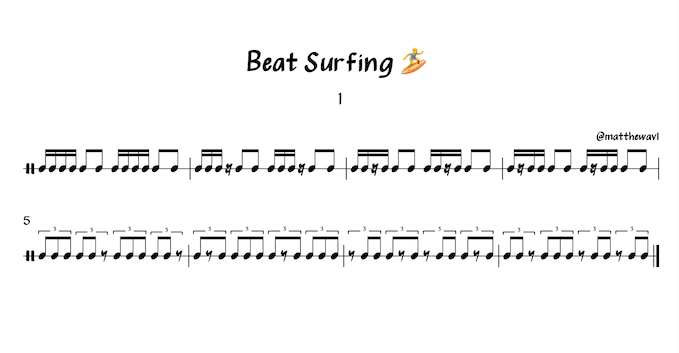
The goal is not just to play the notes correctly. The goal is to keep the pulse steady through every pattern. Feel the time between the notes, ride the beat as it moves forward, and avoid waiting for the next beat to rescue you.
Good timing is not passive. It is active, steady, and alive.
That is beat surfing.